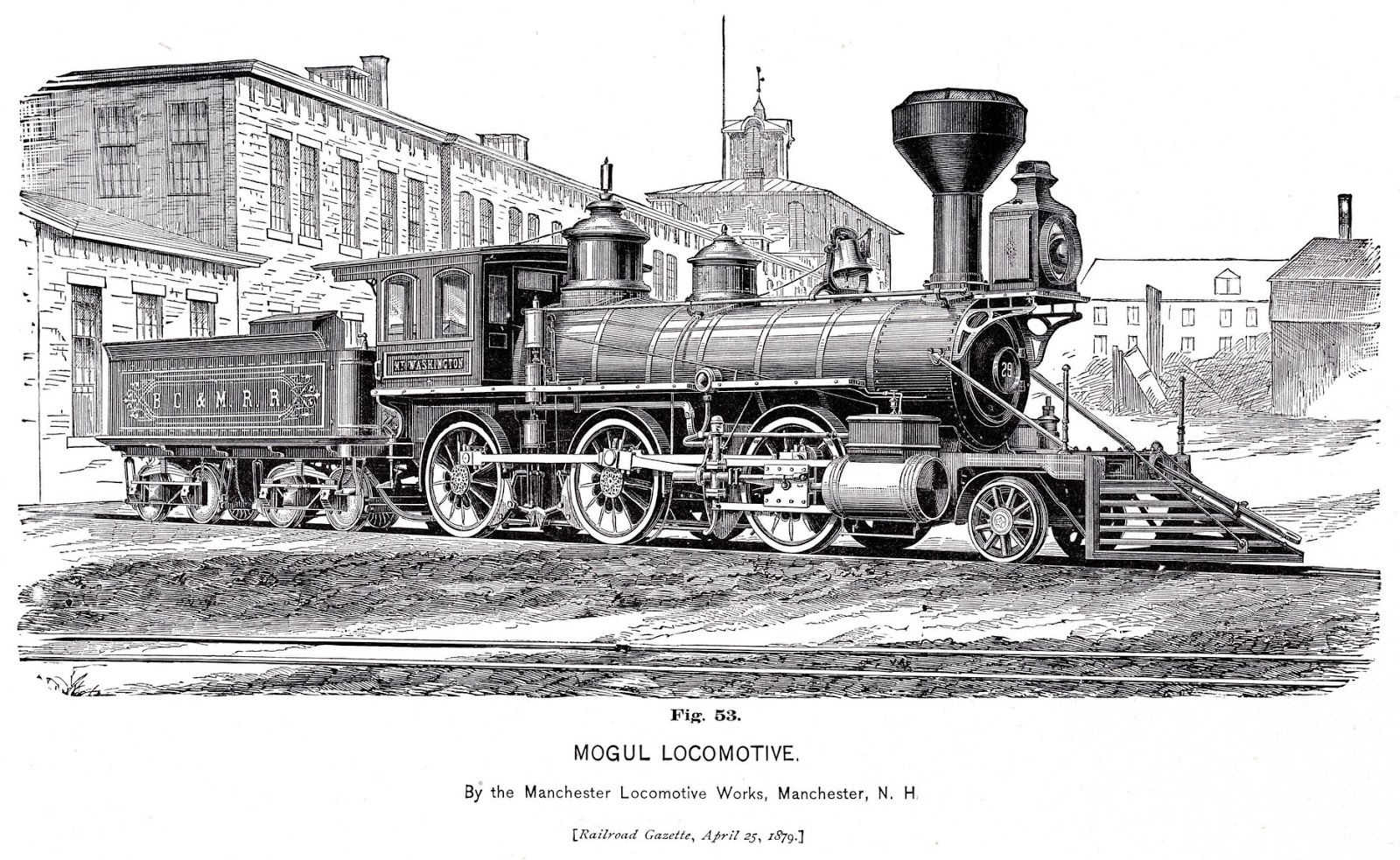
The year was 1883 and the Denver and
Rio Grande narrow gauge recently acquired a number of new 4-4-0
locomotives. These
were designated as the 8-18c class from the Baldwin Locomotive works.
However unlike previous versions of this class of locomotive, these
had the addition of a straight boiler with an rather long firebox for
burning anthracite. One of these
locomotives was allocated the number of 107, and thus a railroading
legend began.
 |
| D&RG 108, sister to the "Dread" 107 |
**************
The Tale of Dread 107
It was said that if ever there was a
locomotive that was possessed by supernatural forces, the 107 was it.
It all started not long after she was put in regular service, in the
spring of 1883, when the Black Eagle Canyon Bridge was washed out
from hard-flowing waters. 107 took the plunge into the river below,
killing her engineer and fireman. She lay in the canyon until the
late summer when the water level was low. Only then she was able to
be retrieved.
 |
| A rare photo of the #107 in service. |
Later, 107 was in her second incident
just out of Gunnison, Colorado on a place known as Blind Man's Curve.
Her engineer and fireman were killed after she slammed into a boulder
that had fallen onto the right of way, rolling onto her side. After
the first two wrecks, the 107 was moved to the Salt Lake City to
Ogden route. For the while, her trips were were rather uneventful.
However, it seemed that trouble wasn't far behind. 107 found herself
involved in a minor derailment, in which a hobo riding the rear of
her tender fell off and under the cars as she left the rails.
By this time, rumors began to spread
among the employees, suspecting there was something wrong with her.
As it went on, the employees and locals began to give her the
nickname "Dread 107", saying she was haunted by ghosts and
demons that would reside in her cab. Engineer Ole Gleason was
assigned her, and after six months at the throttle, he and four
others ware killed in a head on collision.
Afterward, an unknown D&RGW
employee carved 107's records into the woodwork of her cab. this
included the number of wrecks, and the names of those who had died on
board her. Stories were told of ghosts who hid in the roundhouse
shadows whenever she was present.
In the fall of 1889, she was crewed by
the Flynn brothers; Tom Flynn as the engineer and his brother, the
fireman. She was running out of Ogden Yard, when on a trip Tom
noticed the markings engraved inside her cab. The story goes that
insanity struck the engineer, who threw his brother off of the
speeding train, letting the 107 run away. The locomotive overturned
after an insane run down the line, pinning the engineer underneath
her. Tom flailed around, seemingly possessed, and later bled out and
died. Tom's brother also died of his injuries.
The railroad took her to their shops
in Alamosa where she'd undergo a major overhaul, her death record was
erased, and the locomotive was renumbered 100. It was believed that
changing the identity of an engine would break the curse. This seemed
to work, as the locomotive ran uneventfully for a number of years.
That is, until she ran into a ditch due to a washout. Not long after,
she led a gravel train, going downgrade from Mear's Junction to
Alamosa. An engineer by the name of Frank Murphy was at the throttle.
The gravel train became a runaway and met a light mixed train in a
head on collision. Killing five more people in the process. After
being taken back to Alamosa for repairs, her original number was
restored!
107 ran in regular service until 1908
when she was scrapped, after a 25 year career of death and
destruction. Even scrapping the engine couldn't end her terror.
Residents in the Grand Junction area have claimed to have seen her
ghost running down the ex-D&RGW line outside the town. She is
often seen along the Gunnison River between Grand Junction and
Montrose, Colorado. Some say to have heard her whistle, but never see
the engine.
***********
Fun story, isn't it? However, how true
is this tale of locomotive supernatural tomfoolery?
The 107 was indeed built in 1883, as a
part of order of D&RG
Class 42.5 locomotives. These locomotives were essentially class 42s
on the D&RG (Baldwin class 8-18c) from the Baldwin locomotive
works; however they were built with the addition of a straight boiler
with an unusually long firebox for burning anthracite coal. The
firebox wasn't especially deep, but in
order to provide sufficient grate area
it was rather shallow and long. More then likely this
construction resulted in an excessive amount of weight on the rear
driving axle,
and led to a higher center of mass. Thus the locomotives gained a
reputation for being potentially top heavy.
How
many incidents the 107 was involved in as a result of her mechanical
ungainliness is up for debate. However, what can be said for sure, is
that there was never an insane engineer. No narrow gauge 4-4-0s ever
operated on the Rio Grande's Utah lines, nor was there a list of
names carved in the cab walls. For starters, no roundhouse foreman
would put up with such vandalism of a cab in his charge. Likewise,
there simply are no records of a Tom Flynn. Whatever small
derailments the 107 may have had in her life can be simply chalked up
to her propensity to waddle.
After
a rather unremarkable career, the 107 actually was broken up for
scrap in 1908.
The
tales of a ghost locomotive are fun, and as Ward Kimball once said;
“Never let the facts get in the way of a good story!”
However...as in all good tales, there is a grain of truth.
**********
The
Black Swan Locomotive.
 |
| 177, the "Black Swan" |
In
1884, Baldwin built a 4-6-0 for the D&RG. This locomotive was a
part of the 47N class, which would go on to be reclassified as the
T-12s. With the construction number of 7306, this locomotive was
given the road number of 177. The Class 47s were the largest and
fastest narrow gauge ten-wheelers to operate on D&RG irons. They
were acquired to pull passenger trains, and their 46 inch drivers
made them suitable for relatively fast passenger service.
 At
first glace, the 177 seemed just another number on a roster. However,
she quickly started to gain a reputation as a bad luck locomotive. If
only her issues were as simple as ghosts and phantoms.
At
first glace, the 177 seemed just another number on a roster. However,
she quickly started to gain a reputation as a bad luck locomotive. If
only her issues were as simple as ghosts and phantoms.
 |
| The 177 waits while a rock slide is cleared. Seems she had a cloud over her head. |
An
issue of the Salida Mail, dated April 15, 1887
had this to say: Many interesting things have happened since my
last, two weeks ago, which are too state to speak of. Engineer
Philliber is off on account of illness. Pickett is out of luck, he
seems to be blessed with a multitude of slight accidents. That the
177 is an unlucky locomomotive.
Looking past the strange spelling of
“locomotive” ... what do they
mean by unlucky? Railroad men, especially during the
age of steam, could be very superstitious and often were very
religious. There was often times a belief that select locomotives
could become unlucky.
That this superstition had a basis in fact is
indisputable. Some locomotives end up over the course of their
operating careers involved in incidents and mishaps more then other
locomotives of the same road, class, or builder. This reason usually
is a result of mechanical reasons, or even just a simple freak of
circumstances and statistics. It would seem that the 177 would be one
of these locomotives.
 One year before the Salida mail
published this issue the 177 found herself involved in a collision.
Not with a boulder or falling through a trestle: on December 17, 1886
she collided with a cow and rolled onto her side. Killing both her
engineer and fireman. The fireman was doubly unfortunate enough to
have been ill for some time. This trip being the first since his
recovery and return to service. Bad luck all around.
One year before the Salida mail
published this issue the 177 found herself involved in a collision.
Not with a boulder or falling through a trestle: on December 17, 1886
she collided with a cow and rolled onto her side. Killing both her
engineer and fireman. The fireman was doubly unfortunate enough to
have been ill for some time. This trip being the first since his
recovery and return to service. Bad luck all around.
 The 177 was repaired at the
Burnham
shops
on Christmas
Eve
and put back into operation.
The 177 was repaired at the
Burnham
shops
on Christmas
Eve
and put back into operation.
 She was sent to the
Salida shops where we catch up to her thanks to the Salida Mail,
dated January 28, 1887. On April 15, 1887 the 177 ran into a small rock-slide. The locomotive rolled onto her side and down 12 feet into the Creek, injuring her crew. Once again, this required her to be
overhauled. Interestingly, the 107 story also involves a rock-slide.
She was sent to the
Salida shops where we catch up to her thanks to the Salida Mail,
dated January 28, 1887. On April 15, 1887 the 177 ran into a small rock-slide. The locomotive rolled onto her side and down 12 feet into the Creek, injuring her crew. Once again, this required her to be
overhauled. Interestingly, the 107 story also involves a rock-slide.
 Also there seems to be an altercation between the Burnham
and Salida shops. More bad luck on behalf of the 177? Not likely.
More a case of good old workplace rivalry, but still interesting to
note. The locomotive found herself on a regular run between Gunnison
and Grand Junction Colorado.
Also there seems to be an altercation between the Burnham
and Salida shops. More bad luck on behalf of the 177? Not likely.
More a case of good old workplace rivalry, but still interesting to
note. The locomotive found herself on a regular run between Gunnison
and Grand Junction Colorado.
 In November of 1887, the 177 would one
again find herself dancing with lady luck. On Nov 3rd she
was the victim of a train robbery. The Idaho Springs News, dated
November 11, 1887 has this to say: The eastbound Denver & Rio
Grande passenger train was held up by masked robbers at 8:45 this
morning at a point five miles east of Grand Junction. As the train
ran under the bluff, Engineer Maloy discovered obstructions ahead and
whistled for brakes. The robbers
burst their way into both the mail and express cars. Unable to break
into the safe in the express car, the robbers stumbled over
themselves in regards to blowing it. They debated going through the
passenger cars and asking for donations.
In November of 1887, the 177 would one
again find herself dancing with lady luck. On Nov 3rd she
was the victim of a train robbery. The Idaho Springs News, dated
November 11, 1887 has this to say: The eastbound Denver & Rio
Grande passenger train was held up by masked robbers at 8:45 this
morning at a point five miles east of Grand Junction. As the train
ran under the bluff, Engineer Maloy discovered obstructions ahead and
whistled for brakes. The robbers
burst their way into both the mail and express cars. Unable to break
into the safe in the express car, the robbers stumbled over
themselves in regards to blowing it. They debated going through the
passenger cars and asking for donations.

Evidently
they began to get uneasy, and started to fear an uprising by the
passengers. Brakeman William Welch and a passenger, started toward
the front. Not out of any bravery, but more to find out what in god's
name had them sitting for so long. They got two bullets over their
heads for their troubles, and were sent scrambling back to the
passenger cars were the air was decidedly more healthy. Assembling
together the bandits decided to cut their losses, and along with the
engineer they themselves kindly removed the obstruction, bade good
night and struck out into the darkness.
 By now it seems the locomotive
definitely has a reputation as she is noted as a bad luck locomotive.
It seemed that she was constantly
returning to the shops in Salida.
By now it seems the locomotive
definitely has a reputation as she is noted as a bad luck locomotive.
It seemed that she was constantly
returning to the shops in Salida.
The Salida Mail comments on her
constantly with sick and ill engineers, finally conning a nickname
for her based off her paint colors calling her a “Black Swan:” A
black swan being a term that for an unpredictable event that is
beyond what is normally expected of a situation and could potentially
have severe consequences.


 Not
content with merely causing bad cases of the flu, in 1888 lady luck
once again grabbed 177 by the throttle. The Solid Muldoon Weekly,
dated March 16, reported on a run in with train wreckers! No doubt
following up on the train robbers the previous year. A misaligned
switch threw the helper locomotive which was leading the train, then
the 177 followed by the mail car off the main and into a siding where
they tried to take a short cut back to the main through the roadbed.
The end result was a pile up that killed a fireman and dislocated the
shoulder of an engineer. After the accident an examination showed
that the switch rail been pried by some Snidely Whiplash character,
and a light arranged to signal a clear track. It is unknown as to if
the guilty parties were ever caught...however the implications of
“stretched hemp” gives an idea of what awaited them should they
be discovered.
Not
content with merely causing bad cases of the flu, in 1888 lady luck
once again grabbed 177 by the throttle. The Solid Muldoon Weekly,
dated March 16, reported on a run in with train wreckers! No doubt
following up on the train robbers the previous year. A misaligned
switch threw the helper locomotive which was leading the train, then
the 177 followed by the mail car off the main and into a siding where
they tried to take a short cut back to the main through the roadbed.
The end result was a pile up that killed a fireman and dislocated the
shoulder of an engineer. After the accident an examination showed
that the switch rail been pried by some Snidely Whiplash character,
and a light arranged to signal a clear track. It is unknown as to if
the guilty parties were ever caught...however the implications of
“stretched hemp” gives an idea of what awaited them should they
be discovered.
 A
number of years seems to have gone by without enough of an indecent
to require note. That is, until our favorite railroad gossip rag, the
Salida Mail records in October of 1890 that the 177 was once again
held up! No doubt the robbers from more then 15 years ago were back
for an encore. The record doesn't say the details of the robbery, nor
if the men were caught. However, Mr. McKelvey and his hounds were hot
on the trail!
A
number of years seems to have gone by without enough of an indecent
to require note. That is, until our favorite railroad gossip rag, the
Salida Mail records in October of 1890 that the 177 was once again
held up! No doubt the robbers from more then 15 years ago were back
for an encore. The record doesn't say the details of the robbery, nor
if the men were caught. However, Mr. McKelvey and his hounds were hot
on the trail!
 Still,
life couldn't be all bad luck for the 177. They sure felt she was
good enough for the president of the road to have on the head of his
train. Once again, we turn to the daily show with the Salida Mail,
dated November 6, 1891, which reports that she could be found pulling
the dignitary without incident. Likewise, she once again found
herself on the head of the Vanderbilt special in the same year.
Still,
life couldn't be all bad luck for the 177. They sure felt she was
good enough for the president of the road to have on the head of his
train. Once again, we turn to the daily show with the Salida Mail,
dated November 6, 1891, which reports that she could be found pulling
the dignitary without incident. Likewise, she once again found
herself on the head of the Vanderbilt special in the same year.
The
next notation of the 177 was her finally being kicked out of Salida
and winding up on the Chama-Alamosa line sometime after 1900. The
Black Swan vanishes from record until 1923 when she was reclassified
as a T-12. She was removed from service and scrapped in March 1926.
Did the run of luck finally kill her off? More
then likely she was scrapped as the company was trying to clear out
old property following a reorganization in 1924.
************
The
final recorded score is four deaths, an untold number of illnesses,
two robberies, a tangle with train wreckers, and the Vanderbilt
family. The locomotive seemed to have a reputation of bad luck that
speaks to many other smaller incidents and mishaps. Perhaps small and
meaningless had they not occurred to the 177. Is it possible that the
177 was really cursed? A clue could be found with this almost
meaningless comment from the Salida Mail. A larger then usual ash
pan.
Much
like the 107,
perhaps this is the real key to the many mishaps that plagued the
177. This one small change perhaps led to a higher axle loading on
the rear driver. Giving the locomotive an unusual gate that may have
led to some of her minor derailments. The rest are a freak of
statistics, that when coupled with an ungainly locomotive led to an
unjust reputation. The truth may never really be known.
What
is known is that the 177's story would have vanished from history had
it not been for a small notation in “Railroad Stories” magazine.
In the 1930s, the mag ran a small blurb about a cursed D&RG
locomotive. Tales of train robberies, wrecks, and wreckers. It would
seem as if the 177 found herself reaching out beyond her final fate
to tale her story. Except the locomotive recorded was said to be not
the 177....but the smaller 4-4-0, 107. The
blurb did not account the locomotive's follies as anything
supernatural. Just unlucky.
The
tale spread. Getting embellished with each retelling. The book A
“Treasury Of Railroad Foklore” by Botkin and Harlow contains a
retelling of the hoodooed locomotive. Freeman Hubbard's
“Superstitions” also recounts tales of cursed engines, bringing
an element of the otherworldly into the story....and
finally the tale of 107 is brought forth as a ghost story complete with eerie
illustrations in Anthony W Reevy's “Ghost Trains.”
107
is seems, got a bad rap. She
was never cursed, never haunted, and otherwise lived an unremarkable
life. Yet, hidden behind her tale of supernatural
shenanigans lays a very real curiosity in a fellow slim gauge
locomotive: The Black Swan locomotive, number 177.
*******************
Sources:
Salida Mail, Volume VII, Number 45,
April 15, 1887
Idaho Springs News, Volume V, Number
32, November 11, 1887
Salida Mail, Volume 11, Number 91,
April 21, 1891
Salida Mail, Volume 12, Number 28,
September 11, 1891
Salida Mail, Volume 12, Number 44,
November 6, 1891
Salida Mail, Volume 14, Number 99, May
15, 1894
Alamosa Courier, Volume XXIII, Number
7, February 11, 1911
A Big thank you to Josh B for thier help in the research and commentary on this article. His work was invaluable to brining this story to light!


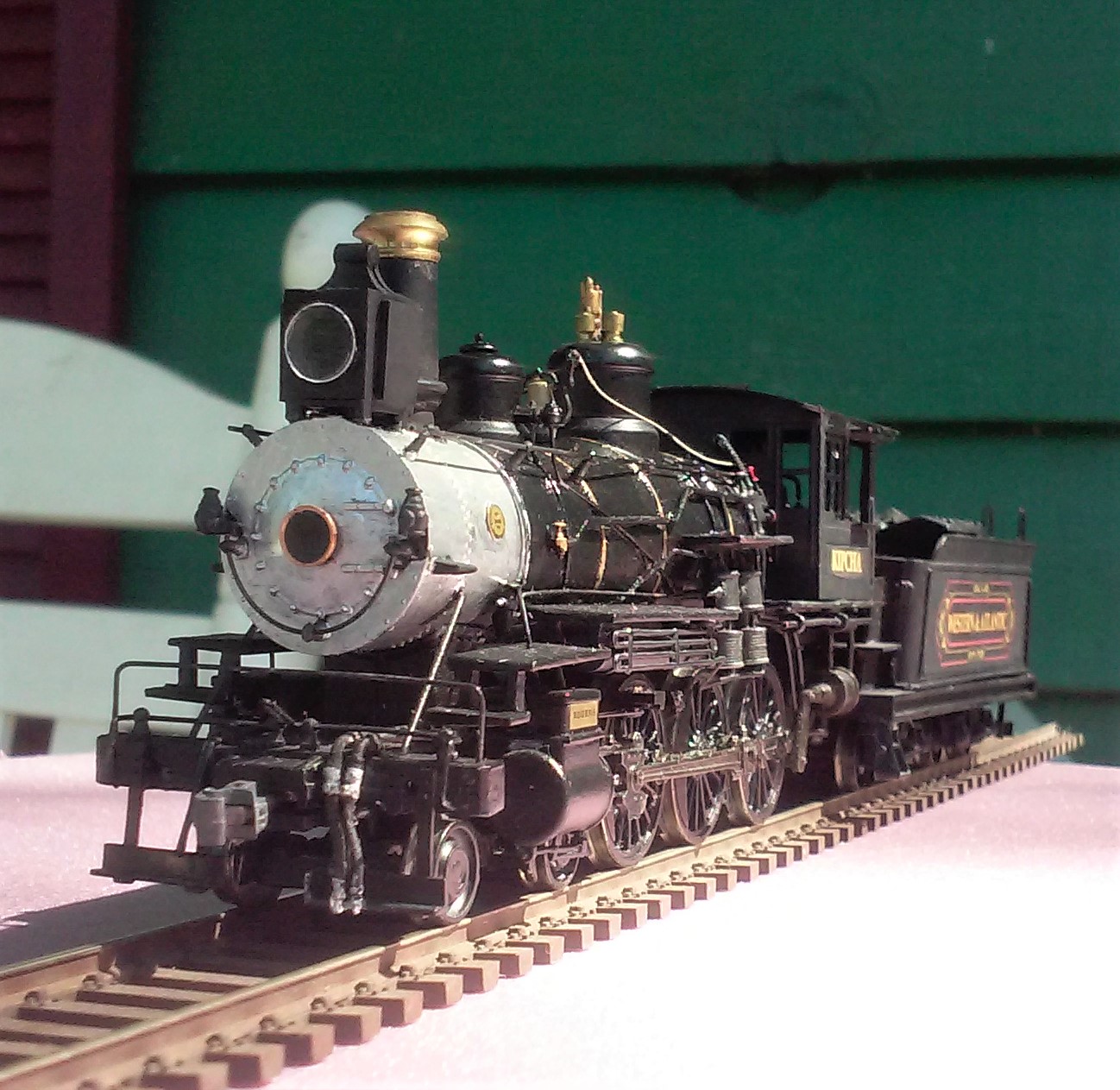
 The motor and flywheel are enclosed in
a metal housing that fills a cavity in the boiler casting. A cogged
belt drives a worm shaft that runs horizontally below the motor, and
the worm drives a worm gear on the main (second) driver. All moving
parts where cleaned and greased. The old paint was stripped, and the
old detailing removed. A new wood MDC cab was fitted to a newly
detailed and painted backhead. Finally, a new coat of paint and new
paper decals were applied to the cab and tender. The box headlamp was scratch built over the end of the LED post.
The motor and flywheel are enclosed in
a metal housing that fills a cavity in the boiler casting. A cogged
belt drives a worm shaft that runs horizontally below the motor, and
the worm drives a worm gear on the main (second) driver. All moving
parts where cleaned and greased. The old paint was stripped, and the
old detailing removed. A new wood MDC cab was fitted to a newly
detailed and painted backhead. Finally, a new coat of paint and new
paper decals were applied to the cab and tender. The box headlamp was scratch built over the end of the LED post.