Showing posts with label Build. Show all posts

Monday, August 10, 2020

Quarantine Project Boxcars

While under lockdown, I attempted to use my suddenly available time productively. I was able to land a number of Central Valley, Labelle, and Roundhouse/MDC kits. The CV and Labelle kits were craftsmen wood kits, while the Roundhouse/MDC kits were plastic and diecast. Sitting down, I started assembling these kits one by one, and in about a month, I had a nice fleet of new cars ready to enter service.

An Xacto knife and sandpaper is all you really need to put any of these kits together. The NWSL Chopper is nice, but not essential. I never used a miter saw for any of these. To help with the roof ends I made a carstock template to guide my carving efforts. One can make one from just a piece of heavy cardboard, or plywood, or Masonite, with the desired curve cut into it for the cutting blade. Use of a template helps to get both ends to look the same. Take it slow and frequently compare it to the provided documentation and you'll be OK. The worst that can happen is that you'll may end up building another piece of roof stock from leftover supplies on hand. (Don't ask me how I know that. Just know that I do.) Prototype wooden roofs were covered with a layer of canvas and then coated with tar. So, any mistakes can be simply covered.

Central Valley Ventilated Boxcar Kit.


Central Valley Boxcar Kit.

Central Valley Refrigerated Car Kit.
 

Central Valley kits are remarkably simple to construct and for their age are decent kits. These kits of Box cars, Reefers, Ventilated Box Cars, and Cabooses were basic wood kits which come with pre-formed and carved wood bases and blocks for the floor and car frame, the ends, and the roof. Traditionally these kits contained all the basswood and soft metal castings required. With pre-printed and pre-scribed wood sides, roof, and ends. The printing on these cars runs the gauntlet of quality. With some carsides being crisp and sharp. While others are dull and blurry. Metal details and the famous Central Valley Trucks with Snap on bolsters are included with each kit. The user was expected to buy trucks and couplers separately. Central Valley made the trucks, but alas they are no more, and it takes some scrounging to find appropriate trucks now-a-days. I tend to replace the metal details with Tichy NBW and brake equipment. As well as replace the brass rod with fishing line for the truss-rods. These make very nice cars that ride well and can be modified to fit a number of prototypes. On the downside, these are old kits. The printing on the carsides can be rather crude. The trucks that come with the kits are clunky and sometimes ride awkward and will require adjusting. A lot of the old casting have imperfections, and as I said before, I tend to use Tichy hardware for this very reason.


Central Valley Boxcar Kit
 

I've built a few LaBelle freight cars and while I love the results, the construction can be a bit of a headache. The kits came with everything except trucks and couplers. I found the destructions confusing, with drawings that are not scale to the parts provided, and the construction methods were straight forward, but made all the more challenging by wood parts and blocks that clearly were planed with old tooling. Warping, odd sizes, and uneven thicknesses abound with Labelle kits.
 

A LaBelle 34 foot boxcar


Labelle 34 foot boxcar

When it comes to painting these kits, one must remember that wood is porous. The varied grain of the scribed siding wood will absorb paint at different rates. LaBelle kits generally use a very good grade of scribed wood, but there is still a possibility that the grain will show through the first coat of any paint. Central Valley cars tend to be pre-printed, so too much paint will obscure detail and grain. One can either use a primer coat or a light application of your main color first - allow that to dry completely - and then a second coat. While the single coat may create a weathered appearance, that wood grain issue remains and I've found it better to use two coats of paint and then go back and apply light weathering if desired.
 

Also recall that dried glue does not absorb paint. Careful gluing is important on these kits to keep the glue from spreading out on surfaces that will be painted. The "second coat of paint" process can help to cover problems, but it is better to avoid the problem as the paint almost always appears more glossy on the spots covering glue. 


I also finished two more of the Crown Point flatcars kits. I covered these kits in an earlier review.  I put Tichy trucks under these ones. 


A few kitbash projects were likewise knocked off the shelf. Such as this tankcar built with a brass shell found in a parts bin at a local hobbystore atop a scratch built car-frame and body. The flatcar with load was built from an AHM flatcar lettered for the local "Stone Mountain Railroad" 


Roundhouse/MDC boxcar

Roundhouse/MDC, and later Roundhouse under the Athern banner, produced a number of 34foot wooden boxcars with trussrods. These cars are typical of 1890-1920 construction, while easy to backdate into the late 1880s. The kits are easy to put together, as they often come with a cast metal frame, plastic spru of parts such as the running board, queen-posts, and brake equipment, an a large body shell. I tend to replace the plastic parts with Tichy hardware, and use fishing line instead of thread for the rods. Otherwise, the cars go together as instructed. Sometimes with a few small details car to car. These are cheap and cheerful cars, and make fine runners. 

Well, that's all I have for this post. I'm back at work, so long spans of hobbytime are over. I have plenty of projects in the works though, and I can't wait until the pandemic lifts so I can return to the model railroad club and give my new freight train's worth of rolling stock some run time.

Sunday, May 3, 2020

Morning In The Shops

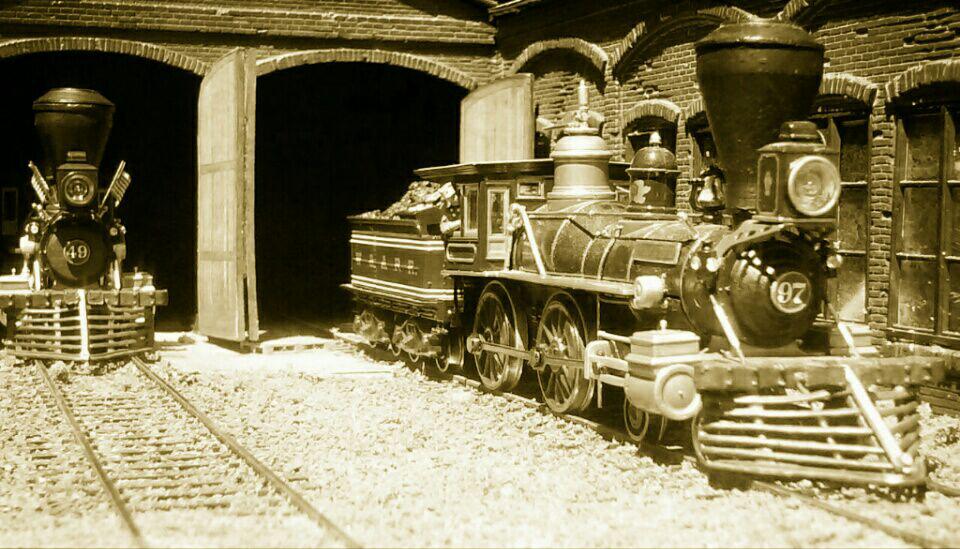
With Covid19 keeping us all home on these beautiful days, I started going through some of the photos taken on my old Atlanta Locomotive Works Diorama. I built the scene originally as a place to take photos of my locomotive projects. However, rebuilding it to include a turntable is what set me off on my modular layout build. 

Just for fun, lets wind the clock back and take a look at the Atlanta Shops. 


 As far as models go, the scene was very small. It was built on a 2x1' foam base with wood side walls. The shop building itself was made from spare Revell "Superior Bakery" wall segments. The same wall segments that would go on to be sourced for the Marceline Roundhouse. There was very little interior detailing. Rather just shapes painted black to give the impression of size and mass. 


The diorama was easy to take outside and pose equipment on. These photos are rather old, and show some of these models in prior shapes and detail packages. Some models, such as the Telegraph, have been rebuilt entirely into new locomotives. 

Still, it helped to take one back to sunny summer days. When the air was full of smoke and cinders. 


Looking at these old photos builds enthusiasm for the current projects. The new layout will be far more then just a diorama, and hopefully scenes like these will be seen again on the W&A RR.

Sunday, April 19, 2020

The Kipcha

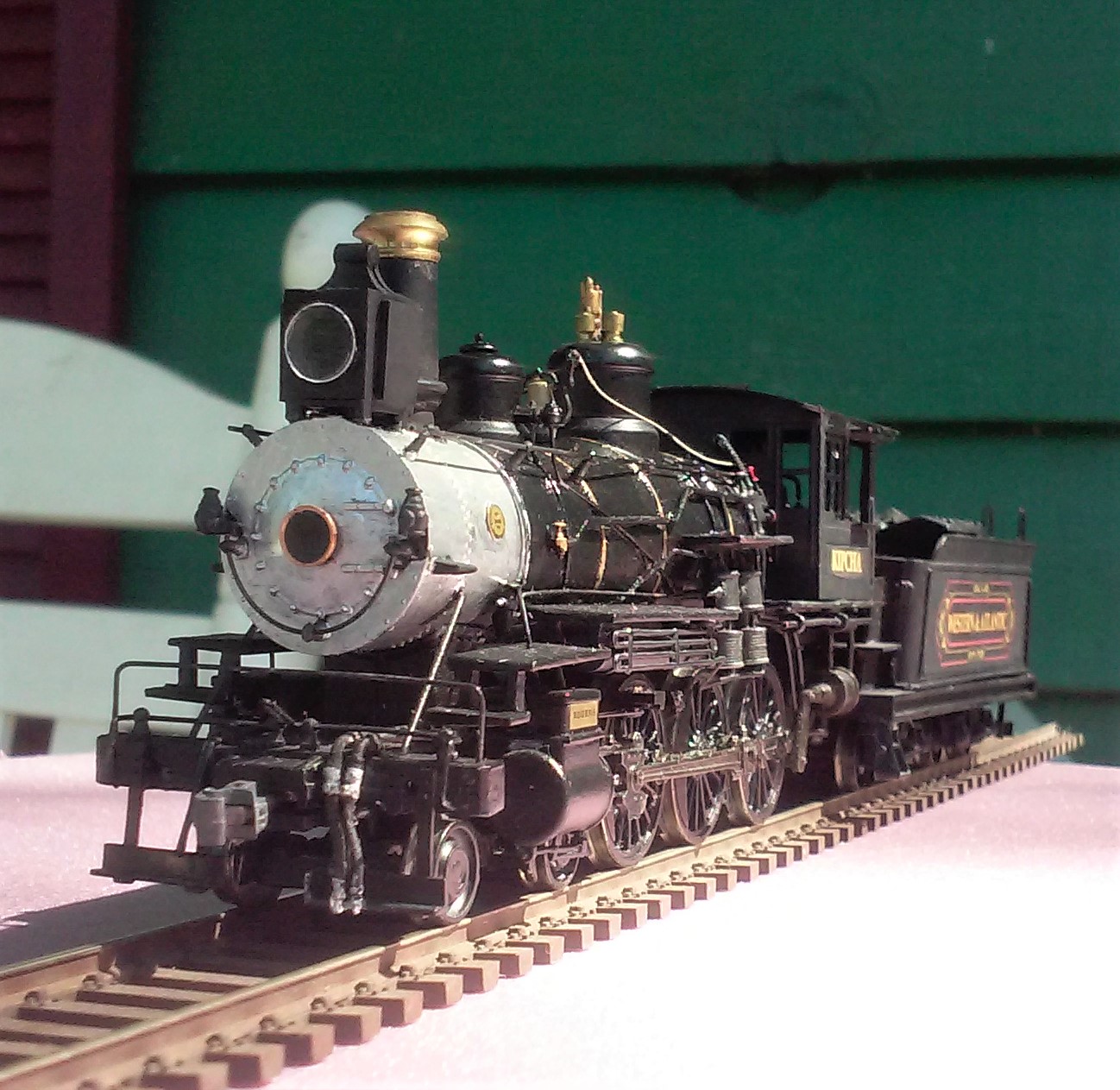
I've owned this Bachmann Spectrum high boiler ten wheeler for almost 7 years. This model has the distinction of being the first sound equipped steam locomotive I ever owned. Equipped with a Tsunami medium steam decoder, it's sound system is acceptable at best. The B-mann claims no particuler prototype for this model other then being a representative of Baldwin Locomotive Works designs of the early twentieth century. Its size and proportions indeed reflect that era. The locomotive retains the slide-valve cylinders of the era when it was supposedly built, but has more-modern Walschaerts valve gear, a MASSIVE USRA tender, electric lighting, and a steel cab which as stock suggests a locomotive that was modernized in the 1920s or later, and may have run into the 1950s. 

The locomotive as she appeared under a previous rebuild.


When I did my original backdating upon purchasing the locomotive, the first thing I did was alter the tender. I got rid of the USRA tank, and instead cut apart a Mantua ten wheeler tank from their Sierra Railroad #3 model. The new tank went on the original frame, and was further detailed. Over the years, the locomotive lost all of the modern detailing, such as the cooling coils for the air lines, the Walschaerts valve gear, and a box headlamp found it's way atop the boiler.

She has carried three names over the years. First named “Enterprise”, she later gained the name “Vitani”, and finally “Scamp.”

Kipcha, looking spic and span.
Mechanically, this locomotive has been a very reliable performer. Never missing a beat, nor giving me any real trouble. However, she is starting to get one in years, and a small quirk has started to emerge where if the locomotive is left to sit for an extended period of time, as she often does in my display case, the decoder doesn't like to respond to commands properly upon the first run. However, this quirk vanishes after a few rotations of the drivers. As well as vanished completely if the locomotive is run regularly. She has been slated for a new LokSound Version 5 decoder.

In the meantime, the locomotive was starting to look rather shabby. So, looking for quick projects to do while I sit at home hiding from the Big Bad Itus, I felt it was time to pull her out of service and go through her with a fine toothed comb. The locomotive underwent a full servicing that involved the removal of the boiler and cab. The boiler may be removed by unscrewing four screws, one between the cylinders and three at the rear of the frame and under the cab. The two deck braces must also be removed from the sides of the smokebox. The cab can be removed by releasing two screws and loosening the upper ends of the rear handrails. Use care to avoid damaging the piping and railings running into the cab's front wall.

The motor and flywheel are enclosed in a metal housing that fills a cavity in the boiler casting. A cogged belt drives a worm shaft that runs horizontally below the motor, and the worm drives a worm gear on the main (second) driver. All moving parts where cleaned and greased. The old paint was stripped, and the old detailing removed. A new wood MDC cab was fitted to a newly detailed and painted backhead. Finally, a new coat of paint and new paper decals were applied to the cab and tender. The box headlamp was scratch built over the end of the LED post.

As a last touch, she received a new name to go with her new look. “Kipcha”, follows my railroad's tradition of naming locomotives after characters from the fantasy book series “The Sight”. A tradition that goes back to my Middle School days.

Hopefully she will give me many more years of pleasurable operation.

Sunday, March 29, 2020

The 2-6-0 Project. Part 1


Steam locomotives are impressive, captivating, ingenious, complex, and dangerous devices all wrapped within a single frame. Nothing else in railroading has ever been quite as alluring. 

Prior to the turn of the last century, the 4-4-0 class of locomotive was perhaps the most successful, and most common wheel arrangement. These ran the gauntlet of design from colorful and gilded trimmed machines of the 1850s and 60s to the robust and
conventional units of the 1890s and the early 1900s.

According to Wes Barris' authoritative website, SteamLocomotive.com, there were around 25,000 of the little buggers manufactured from the mid-1800's through the following century. More then any single class of wheel arrangement before, or since. No surprise this class gained the name “American”.

The archetypical 4-4-0. Baldwin built. Circa 1870


Before I go any further, let's touch up on locomotive classes. On this blog, I toss around a lot of numbers. 4-4-0, 2-6-0, 4-6-0, and more. The technical term for this is the "Whyte Notation," developed by Frederick Whyte, which classifies a locomotive by its wheel arrangement. The system counts the number of lead wheels (non-powered, found at the head-end to negotiate curves), driving wheels (located directly under the boiler, providing all power and adhesion), and finally the trailing wheels (also non-powered these are located near the cab for support of the firebox and weight displacement), all of which are separated by dashes. 


The 4-4-0 in all it's mechanical glory
The American's Whtye Notation is broken down as follows: "4" lead wheels (two axles), "4" drivers (two axles), and "0" trailing wheels. Thus...a 4-4-0. (And the “0” is pronounced as “oh” not “Zero”. If you see a friend pronouncing a class as “four, four, zero”, and not “four, four, oh”...well, you need better friends. ;-) )


The iron horse continued to grow in an effort to meet demand and as boiler building technology and metallurgy allowed larger boilers and stronger frames to become available. Other popular 19th century wheel arrangements included the 4-6-0 Ten-Wheeler, 2-6-0 Mogul, and 2-8-0 Consolidation. These successful designs gave way to the technologically advanced variants of the post-1900 period.


A roster of the W&A RR Circa 1862. All 4-4-0s.
So far, the motive power fleet of my W&A RR consists of six 1860s-70s 4-4-0s, one 4-6-0, and one 1890s 4-4-0. Historically, the real life Western & Atlantic mostly ran with 4-4-0s, although a batch of Baldwin 4-6-0s was obtained in the 1880s. Part of why I wanted to model a fictional version of the W&A was to expand upon this fleet with "could have been" pieces of motive power.


Two wheel arrangements I wanted to tackle were the 2-6-0 Mogul, and possibly the 4-8-0 Mastodon. Both projects I put off as I worked on perfecting the 4-4-0s. Part of the reason being that there really aren't good representations of these wheel arrangements available as ready-to-run 19th century locomotives. There are some older models, such as Mantua open frame motored varieties, all based on the movie diva-I mean-star, Sierra Railroad #3. However, these older models have very poor molding, open frame motors, and the amount of work to re-motor them and deal with their running issues would be paramount to building from scratch.
The typical 1870s 2-6-0. As built by the Brooks Locomotive Works


There is the Model Die Casting/Roundhouse 2-6-0 “Old Time” model. The kit was pretty common from the 70s on through the 90s, and to this day you can find dozens on ebay. 

An MDC 2-6-0 with the fat boiler that was present on all MDC old timers.
I had never really liked the MDC/Roundhouse models because they were kind of odd— odd-drivered, with a high-mounted, straight, fat boiler. (The same boiler across the line of available models) It was hard to find a prototype that resembled it. Definitely not a typical 2-6-0 for my 1880–1890 modeling period.


John Otts, owner of the wonderful Miskatonic Railroad published an article on building his own 2-6-0 using the MDC/Roundhouse 2-6-0. His site is a gold-mine of information, and well worth a look. This got me thinking about the possibilities in the MDC frame.
Marco's 2-6-0 project loco


Then, as I did research into the idea, my friend Marcos Hizizal started working on his own 2-6-0 project by combining a MDC/Roundhouse small driver 2-6-0 frame and running gear with an old AHM 4-4-0 wagon-top boiler and cab. He nursed and developed the idea enough to get a model up and running of his own design. Watching him, and witnessing his trial and errors gave me enough thought to attempt a similar style bash on my own. 


I started out by obtaining a second hand MDC model from everyone's favorite online auction website. It came as "new-old stock", and had never been out of the package. I pulled the model from it's packaging to instantly discover that it had an odd knocking noise coming from the mechanism, and that it ran with a clear "thump". After much diagnoses, takeing things apart and putting them back together multiple times, some fowl language, and a beer, it turned out it had a cracked spur-gear that needed replacement. 

Well done MDC, well done.


I already had a AHM 4-4-0 boiler and shell, from a model that I picked up second hand. While Marcos took the original 2-6-0 and worked some voo-doo magic to rebuild the spur-gear.


The general idea of the build was to graft the AHM boiler to the MDC frame. This required a little butchering on behalf of the AHM boiler. I stripped the boiler of all components and paint, before giving it a good solid cleaning. I massaged the boiler so it would snuggle down more on the frame, and rebuilt the running-boards out of styrine so that they lost the "diamond plate" pattern that was cast into them. 

Test fitting the frame and boiler.

While this was happening, Marcos determined that the spur-gear was a loss, and quickly magicked up a 2nd MDC 2-6-0 doner. I assume he had to sacrifice a virgin and a lamb to do so. Either way, I'm indebted to him for popping another MDC out of then air. Once I had the MDC loco back, I disassembled the model down to it's frame, removing the pilot and lead truck. A new pilot would be fashioned and I added a new lead truck using a the old MDC lead truck assembly with a NWSL 26" flush end wheelset. To help with weight, a stick on lead weight was added between the frame. 


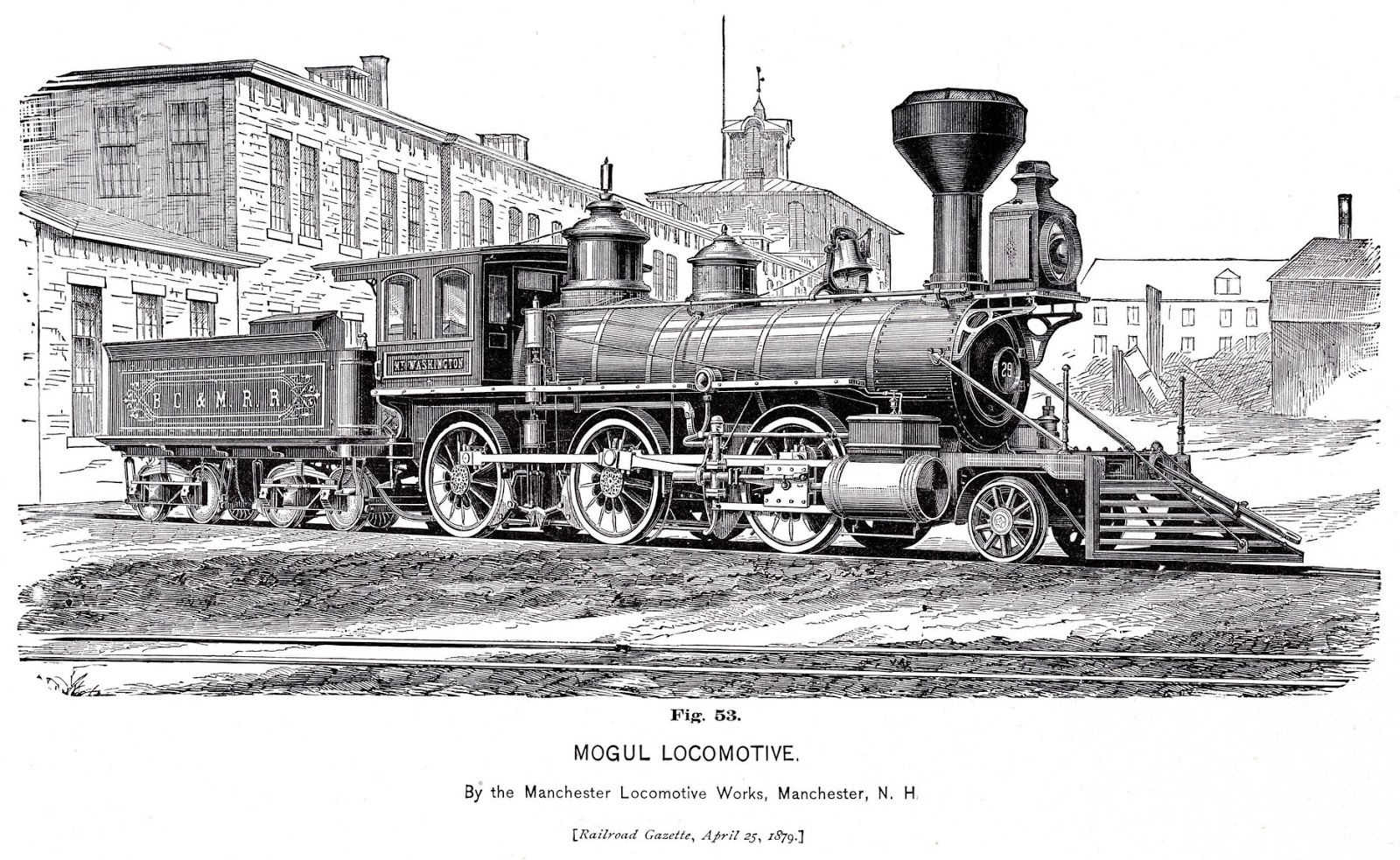
 The locomotive has a real Civil War look to her thus far. Which I really do like. I've started aiming for a locomotive that looks like a Manchester or Rogers product of the late 1860s or early 1870s. The big balloon stack helps to hide more weight. There is still a lot of work to be done. Such as a tender to scratch build, wiring to be done, and a decoder and speaker to fit. 

The boiler and runningboards


The weight between the frames.


Freshly painted cab!


More on this project as it develops...


Tuesday, February 25, 2020

The Turntable, Part 2


Almost a full year ago, we took a look at the turntable project for Marceline. Which can be read here. Since then, I had a rethink about the plans surrounding this aspect of the project. We had tried a few alternatives around building the turntable bridge and making it work based on the Atlas turntable and it's construction. However, the drawbacks started to mount. I remember reading once that the value of a reviewer is to make mistakes so the reader doesn't have to.
Turntable MK1


To start with, the Atlas turntable has a Geneva drive that that translates the continuous rotation of the handle into intermittent rotary motion of the table, thus allowing it to automatically index itself with tracks. This drive is what moves the bridge based off the handle or motor kit that Atlas provides. When we pulled the large circular full deck bridge off, this aspect of it's motion was lost as was the drive. Which forced us to try and rig up a few alternatives.

First, we tried cutting the original deck apart into a bridge and running it off an Ho scale drive motor from MTH. This resulted in a gear reduction ratio that was near impossible to channel in for a realistic speed on the bridge. The end result being the bridge turning like a record player, or was too little and light to move the weight of locomotives. In the process, we destroyed one Atlas turntable.

Oh well, back to the drawing board.

Turntable MK2
One order from Atlas later, and our second turntable was under construction. Like the first, we cut the bridge out and this time tried to mount a handle and gear reduction to the outside of the module. So the turntable would be turned by hand. This worked for a while. That is until the turntable had a load put on it. In which case we sheered the drive shaft and cracked the gear that translated motion from the handle to the shaft.

Oh, and we destroyed that turntable in the process. 

Back to the drawing board...again.  

Having outright scrapped the original Marceline module in favor of a fresh start, the decision was made to abandon rebuilding the Atlas turntable. Instead, we would use the turntable as a foundation. An order from Atlas produced our third turntable. This time, however, it would not be the one the public saw. Looking over the problems, Tyler the Beguiler and I hashed out a pretty neat solution. 


The Atlas turntable and it's motor would be left stock. Instead they would both go at the bottom of the turntable pit. Which was dug deep enough to except them below the scale level of the pit floor. A new turntable bridge would be scratch-built to go atop the Atlas turntable. Taking it's power from wires soldered directly to the rails on the Atlas. A spacer would hold the new bridge at the correct level, and a false floor would go atop the Atlas to hide it's rotating deck from view. It was simple, elegant, and most of all, no longer required us to re-invent the wheel! 


The tabletop around the roundhouse was made from 2 inch pink insulation board. Which gave a great surface to cut the pit into. Once the pit was cut and the pit walls constructed from card-stock, the Atlas turntable was sunk into place. A foam-core top was built to sit around the turntable and over the motor pit. If for whatever reason the motor of the turntable needed to be accessed, it can be done so either by lifted up on this foam-core top, or by pulling the motor unit out from the bottom. 

 The design of the turntable bridge also was a big consideration. By the 1880s, wooden bridges such as the classic "gallows" style bridge were being replaced by ones made of iron. Many different designs were available for use. From iron girder style bridges that required manpower to turn, to electric and steam power. 

In 1890, John B. Collin was a mechanical engineer for the mighty Pennsylvania Railroad, based in Altoona at that road's engine shop. Plans had been developed in 1886 for a new shop, located in the Juniata section of Altoona, to be completed in 1890. Collin, who was a bit of a madlad, designed a turntable that was powered by a vertical boiler and steam engine. The engine was mounted on a separate operating platform with an arm that was attached to the main body of the turntable bridge. Powering a drive wheels underneath the working platform. While there is no evidence whatsoever of the historical W&A RR having owned such a turntable, it's design fit the bill for the fictional Marceline and was unique enough to warrant modeling. 

While this was going on, Tyler was doing an experiment related to another project. Building model railroad bench-work out of foam-core. While this is a topic for another post, one of the side results was that he had quite a bit of foam core left over. Thus, a usable material for building the turntable bridge became available. 


The bridge itself was made from foam core, with cardstock lamination to build up the plates of iron. Rivits where made by dipping a toothpick in white glue and 'dotting' it along the plate. The deck of the turntable was made by hand, using code 55 rail, and cutting lumber with a chop-it. The walkway boards where likewise hand cuts and stained individually before being glued to the deck. 


The space around the bridge was leveled using more foamcore. This will have to be painted and sealed prior to any scenery. Otherwise the foamcore will swell.

 The engine that drives the turntable was scratch built using a passenger car stove from a Bachmann On30 coach. Other
shapes where made from stryine and the cylinders and levers where from a Tichy crane kit I bought second hand as parts. It was only after I built the boiler, engine, and it's platfrom that I discovered that I already had a vertical boiler casting in my parts bin. Oh well, I actually like the current boiler a little better. 


A lot of work left to do. Yes sir. A lot of work.


Monday, January 20, 2020

The Roundhouse, Part 1.

Photo by fellow modeler Ethan.
Well, I hope everyone enjoyed that little tale. I'm planning on posting more of my W&A Disney/Alternate Universe here. However, don't think this sit is going to turn 100% into a Disney fan-site. There is still a lot of serous model railroading to do. 

2020 is here, and work continued on the W&A RR. One big project I started tackling was the construction of the roundhouse itself. The railroad roundhouse goes all the way back to the early years of the railroad industry with the first known of its kind having been said to have been built in Derby, England in 1839. As steam locomotives grew in size so did the building. Steam roundhouses were dark and drafty places. Usually full of smoke and the thick scents of hot locomotive oil, ash, and soot. Most structures could hold more than two dozen steam locomotives and acted more as a maintenance/storage building then a heavy shop. Since steam locomotives had to stop often to refuel and required much maintenance from their handlers, just about every large yard across the country contained a roundhouse of some size to provide such and turn them if needed.

The Marceline roundhouse has 10 stalls and is made up of two separate buildings. The first roundhouse on the site was a brick structure that contained 5 stalls and was erected in the 1870s. Later, in 1882 as Marceline became a division point and repair and service facility, the need for more stalls saw the construction of a second section. The 1882 house was built from granite quarried at the nearby Stone Mountain. 

From day one, the idea was to scratch-build the roundhouse. Due to the confinements of the layout, the roundhouse would have to be a bisected model. With half of the house being a false-front that faded into the backdrop. The end result would be a 10 stall roundhouse where only 7 stalls could be used. Of that 7, 5 could except any sized locomotive in my fleet. The other 2 would only be capable of taking the 0-6-0 saddle-tank, or one of the 1860s 4-4-0s. 
Early track plan. Note the roundhouse only has five stalls at this stage.


After Tyler developed the trackplan, we made a full size drawing of the roundhouse footprint and track-plan to build the model off. Tyler taking his time and actually drawing an architectural plan.

My first attempt was to cut the wall segments from crescent board and foamcore, then layer them with Plastruct stone and brick sheets. To this method, I built a test wall. Complete with windows. Then weathered and painted it. It looked okay, but it failed to have the desired effect I was looking for. 

Then, I remember a diorama I had built some years back, where I used the wall segments from a Revell Superior Bakery/Weekly Herald/Engine house to make the walls for the shop building. Superior Bakery, the Weekly Herald, and the enginehouse were all variations on the same kit, all using the same basic parts and went together in a similar fashion. One or two areas of the kit have interchangeable inserts, to allow for some variation in placement of doors and windows. I still had two kits left over. A bakery and an Engine house. I had to splice few sections together, but these made up the sidewalls of the structure. The back-walls were made from foam-core. 


A nice touch to the stone roundhouse was the peaked facade, complete with a date engraving. The facade was from an Kibri Town Hall kit. One of the nice things about the Revell parts was the architectural trends that date back to the appropriate era. Such as the 'eyebrows' over the recessed window ledges and the stone support pillars that can be seen inserted in the walls.

The roundhouse roof was made from crescent board. The stone boarders and door frames were made from wood. I wanted the roofs to have the look of a copper plated roof. The roof was laminated with a layer of aluminum foil end to end. The foil was creased and glued over some of the raised detail such as support beams, gutters, and tar patches and helped mold the whole structure together. Panel lines and patches were scribed into the foil. Then the whole thing was primed with rustoleum primer, and painted.


To achieve the copper effect, Polyscale "NYC Jade Green" was diluted with water and washed over the roof. It took a few washes to achieve the look, but the slight green tint really accents the copper roof. A few tar patches using Applebarrel "Pavement" acrylic paint completed the roof. 

Painting the walls of the stone roundhouse was a relatively simple process. They were first primed with Tamiya primer, and then a coat of "Granite Gray" from Applebarrel was applied to the whole structure. a light gray was then dry brushed in a number of coats to bring out detail on the raised surfaces. Finally, some weathered with applied also with drybrishing. I currently do not own an airbrush, so most of my weathering and painting is a variation of dry-brushing and washes. 
Flipped upside down, we can see the dark and smoky interior.


The interior is held up by several beams and joists made from basswood. The whole interior is painted with a mix of camouflage brown and black. Going from brown to black, front to back. I decided not to detail the stalls and instead go for this shadowy smoky black interior in order to hide the fact that the roundhouse is partially a false front. 


The front doors are leftovers from two set of Walther's Roundhouse kits that I built for our model railroad club's own steam facility. These where painted and dry brush weathered. The doors were set up to open inward so as to provide a clean look to the front of the house.


Things left to be done include the entire brick roundhouse, smoke-jacks (Which I intend to have 3D printed) and a number of smaller details around the structure. Construction has also started on the second half of the roundhouse, the older brick house.